Menu
Plan my trip
Witch's Rock & Ollie's Point, Costa Rica

Costa Rica surf guide

Surfing Witch's Rock & Ollie's Point

Boat-access national-park waves, the Endless Summer classics

2 waves · Best Dec-Apr · Intermediate, Advanced · From $46 a day

Northern Costa Rica's driest, most consistent surf province. A near-180° swell window keeps south-west groundswell and north-west winter pulses funnelling in almost year-round, feeding everything from Tamarindo's beginner beachbreak to the boat-access barrels of Witch's Rock and Ollie's Point. Warm water, offshore mornings and easy infrastructure make it the classic first taste of Costa Rica.

LevelsIntermediate, Advanced
Best seasonDec-Apr
RegionGuanacaste
Daily budget$46–210
Nearest airportLIR

The waves at Witch's Rock & Ollie's Point

Potrero Grande (Ollie's Point)Intermediate / Advanced

Right Point · Best May-Oct · 3-8 ft · Crowd 3/5

Big S or mid W swell, offshore

Ollie's Point is a right point inside Santa Rosa National Park, in the far north of Guanacaste, and the wave that The Endless Summer II made famous. It needs a solid south swell or a medium west swell, and then it runs down the point in long, even walls, with a section that gets hollow at low tide.

The shape is predictable, which makes it a good wave for working on your turns, and the boats arrive as soon as the forecast looks good. The only practical way in is by boat from Playas del Coco or Tamarindo, and it isn't cheap. Take repellent: the mosquitoes are fierce.

Full guide to Potrero Grande (Ollie's Point)
Playa Naranjo (Witch's Rock)Advanced

Beach Break · Best May-Oct · 3-10 ft · Crowd 3/5

S-SW swell, howling offshore

Playa Naranjo is the beach behind Witch's Rock (Roca Bruja), the big volcanic rock off the coast of Santa Rosa National Park in Guanacaste. It's one of the best-known surf spots in Costa Rica, with hollow A-frame peaks that hold their shape in the strong offshore wind.

It's best around mid to high tide on a medium south or south-west swell. When the swell gets too big it closes out. The shorebreak is heavy and the current strong, so it's for experienced surfers.

There's no road access in the wet season and nowhere to stay. Most people come on a day trip by boat from Playa del Coco or Tamarindo, often combined with Ollie's Point.

Full guide to Playa Naranjo (Witch's Rock)

Where to stay in Witch's Rock & Ollie's Point

There's no accommodation inside the national park, base yourself in Playas del Coco (closest to the boat ramp) or Tamarindo and run day trips by panga. Witch's Rock is best in the dry season (Dec-Apr) with the offshore Papagayo wind; Ollie's Point needs a south swell, so it works from about April to October. Both need a decent swell to justify the boat cost.

Surf camps in Witch's Rock & Ollie's Point

We are adding local camps we trust to this page. Run a surf camp or surf house here? We would like to hear from you.

Before
you go

Book ahead

The dry-season peak (Dec-Apr) fills Tamarindo and Nosara, so book a few weeks ahead. Witch's Rock / Ollie's boat trips are arranged locally day-to-day once you see a swell.

The water

Guanacaste is largely malaria-free. Real hazards are the sun, heat and dehydration, plus sea-lice, the odd jellyfish and strong rips. Clinics in Tamarindo/Nosara; hospital in Liberia.

Who it suits

Petty theft from beaches and rental cars is the main hassle. Never leave valuables visible. Sharks and crocs cruise the Potrero/Naranjo rivermouths but attacks are essentially unheard of.

Money

ATMs in Tamarindo, Nosara and Liberia are reliable; carry some cash for sodas, panga trips and the smaller villages. US dollars are widely accepted alongside colones.

Best time to surf Witch's Rock & Ollie's Point

Witch's Rock & Ollie's Point works best around Dec-Apr.

JanFebMarAprMayJunJulAugSepOctNovDec
PrimeGoodQuiet

Costa Rica or Panama? Compared for surfing

Indonesia or Costa Rica? Compared for surfing

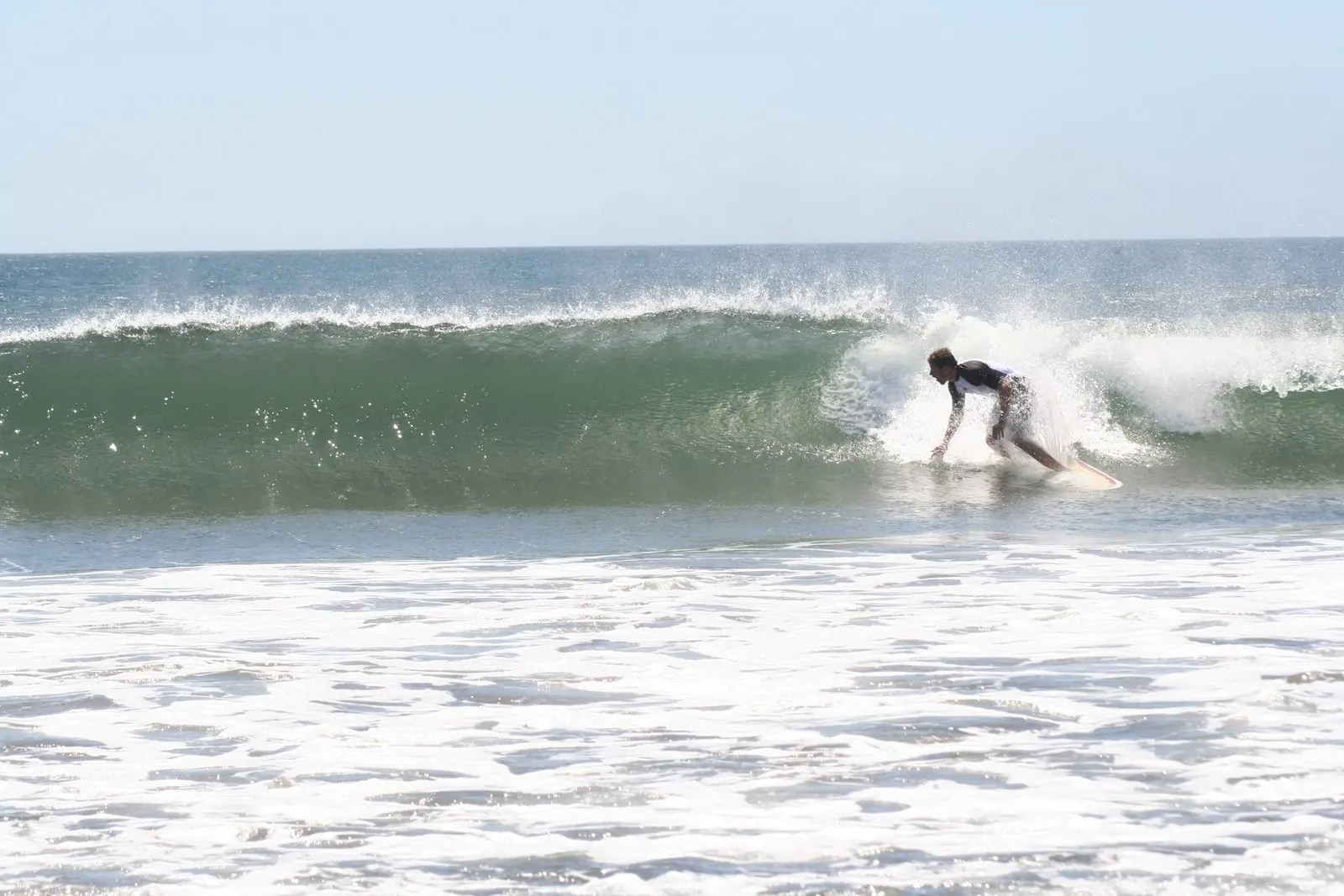
Surfer on a wave at Witch's Rock, Guanacaste
Photo: dog4aday, CC BY 2.0

Getting to Witch's Rock & Ollie's Point

Liberia's international airport puts you on the sand in under two hours. A 4x4 earns its keep on the wet-season dirt roads and river crossings, while the marquee national-park waves are boat-only.

Liberia airport (LIR)

$80-250 from US/EU

Daniel Oduber (Liberia) lands you 1-1.5h from Tamarindo, far closer than San José (5h). Airlines charge roughly $80-105 each way for a board bag. For the Guanacaste beaches, fly into Liberia rather than San José. It saves a long drive.

4x4 rental

$35-55/day

A high-clearance 4x4 is close to essential in the wet season, when river crossings and mud can strand a normal car. Roads have improved but still bite. Never drive at night, wildlife and unlit trucks make it genuinely risky out here.

Panga boat trip

$250-450 per boat

The only way into Playa Naranjo and Potrero Grande is a panga from Playa del Coco (or a rough dry-season 4x4). Operators run day trips when the swell is up. Split the boat between four surfers and it's far more affordable, and the captain knows the tides.

Tourist shuttle

$40-55 per seat

Shared shuttles link Liberia and San José with Tamarindo, Nosara and the surf towns, comfortable and hassle-free if you don't want to drive. Book a day ahead; surfboards travel for a small surcharge.

Scooter / quad

$25-40/day

Fine for buzzing between Guiones, the village and nearby beaches on dry roads, but not for the longer river-crossing missions. Great for the Nosara area; leave the serious spot-hunting to a 4x4.

Beyond the surf

Santa Rosa National Park

Nature

Dry tropical forest, howler monkeys and the historic hacienda, the park that shelters Witch's Rock and Ollie's Point. Dry-season access only.

Playa del Coco

Town & boats

The launch point for panga trips to the national-park waves, with dive shops, restaurants and the area's liveliest little seafront.

Rincón de la Vieja volcano

Adventure

Active volcano with hot springs, mud pots and waterfall hikes an hour inland, the classic Guanacaste flat-day mission.